EarthSpark Research Paper
Summary:
The 1980s in the United States was a decade marked by the rise of political conservatism and homophobia. Shaped by the conservative context, Transformers characters were designed with exaggerated expressions of masculinity and femininity rooted in heteronormative and cisnormative ideologies, reflecting a cultural desire to return to “normalcy” through the assertion of the gender binary. Transformers: EarthSpark (2022) represents a modern vision for the franchise, attempting to break out of the mold of gender binary through the inclusion of Nightshade, a non-binary character. Yet, the show ultimately falls short of fully subverting the dichotomy of masculinity and femininity. Nevertheless, Nightshadeʼs experience of self-discovery and alienation emerges as a narrative of trans experience in navigating a hostile environment, revealing the very concept of transforming robots to be undeniably queer. The evolution of Transformers from an androcentric franchise to a more queer and inclusive one is driven by the ongoing struggle between its LGBTQ+ fanbase and corporate executives, highlighting the tension between the consumer demand for genuine queer representation and the corporate inclination to favor safe, marketable, and conformist content.
Notes:
As part of a humanities program I'm in, the spring quarter of our 1st year of college is dedicated to a research project which culminates in a research paper. We can choose to write about anything, as long as we relate it back to the course theme of "worldbuilding". I, of course, picked Transformers to be my topic because it was my Newest Interest and also I hold EarthSpark Season 1 to be near and dear to my heart.
I think I've earned the bragging rights to proudly announce that this paper was selected to be in the top 11 out of ~700 submitted papers! I held off on putting this up on my website because I thought it was gonna be published on the program's website and I didn't wanna get doxxed lol. But it turns out they won't be doing that anymore & also removed past essays from their site to prevent LLM scraping. Though the essay name will still be listed on the website, which is why on this page it's just got the generic "EarthSpark Research Paper" title. Trust me my original title is really cool and epic :P
This paper was originally completed on June 6, 2025, with minor edits made on March 23, 2026.
The 1980s in the United States was a decade marked by the rise of political conservatism and homophobia, exacerbated by the AIDS crisis. It was during this period of political, economic, and social instability that the Transformers franchise came into inception. Shaped by the conservative context, Transformers characters were designed with exaggerated expressions of masculinity and femininity rooted in heteronormative and cisnormative ideologies, reflecting a cultural desire to return to “normalcy” through the assertion of the gender binary.
As societal attitudes have shifted since the 1980s going into the 2020s, becoming more accepting of alternative sexualities and gender identities, so too has the franchise. Transformers: EarthSpark (2022) is the franchiseʼs response to the changing demographic of its consumer base, representing a modern vision for the franchise. EarthSpark attempts to break out of the mold of gender binary through the inclusion of Nightshade, a non-binary character. Yet, the show ultimately falls short of fully subverting the dichotomy of masculinity and femininity. Nevertheless, Nightshadeʼs experience of self-discovery and alienation emerges as a narrative of trans experience in navigating a hostile environment, revealing the very concept of transforming robots to be undeniably queer.
The evolution of Transformers from an androcentric franchise to a more queer and inclusive one is driven by the ongoing struggle between its LGBTQ+ fanbase and corporate executives, highlighting the tension between the consumer demand for genuine queer representation and the corporate inclination to favor safe, marketable, and conformist content. This paper will analyze the construction of gender through character design in Transformers, explore the queer worldmaking of Transformers: EarthSpark, and examine how consumers actively contribute to the evolving worldbuilding of Transformers.
Part I. Science Fiction, Character Design, and the Gender Binary
As a work of science fiction, the character design and narrative of the Transformers franchise follows a common trope within the genre where non-human, alien characters are given gendered traits that uphold dominant societal norms. In theory, science fiction (sci-fi) is a genre that promises limitless possibilities, unrestricted by the rules of reality. It is an open playground for challenging existing cultural norms and exploring alternative societal structures, including the construction of gender. Yet, while individual works of sci-fi may experiment with the concept of gender, gender studies researcher Anamarija Šporčič finds that the majority “do not pose any gender-related questions whatsoever.” Instead, most writers opt to use the gender binary—the classification of gender as either male or female—as an “anchor” of reality to situate the reader within the fictional world and help them “feel more at home” (Šporčič). The use of the phrase “feel more at home” by Šporčič highlights an interesting phenomenon: the existence of gender and the societal expectations that accompany it are so entrenched in reality that it is almost impossible to imagine a world without them. As a result, non-human characters in sci-fi are often (intentionally or not) given gendered features not only as a way to ground the story in reality, but also to make the characters more relatable to a predominantly cisgender audience. The Transformers franchise is no exception to this, with its alien characters adorning hyperfeminine/hypermasculine features that reinforce the gender binary and gender essentialism, which posits that there are traits inherent to the male or female gender.
The representation of the gender binary in media like Transformers—so ubiquitous that it often goes unquestioned—illustrates how gender is reinforced through repetition. This repeated enactment of socially accepted yet arbitrary gender norms is what Šporčič terms the “hetero scripts”, rules that one must follow according to their gender assigned at birth, conditioned into all of us from a young age. For example, the convention that dolls and makeup kits are for girls, whereas boys should play with toy trucks, guns, and Transformers. Thus, the paradigms of womanhood and manhood, as well as gender identity, are reinforced by their recreation in everyday lives. These performative gendered traits extend beyond behavior to clothing and the representation of the ideal female or male figure in popular media. In the view of film and media studies scholar Laine Marshall, character design thus becomes “the embodiment of oneʼs conception of gender.” To fully understand the construction of gender in Transformers, we must first examine the franchiseʼs origin as an androcentric franchise catering mainly to a male audience.
Considering what Helen Merrick, researcher of feminism in science fiction, describes as the “populist notions of the overwhelmingly masculinist nature of sf [science fiction],” it is no surprise that Transformers was marketed as a “boyʼs toy”. Many sci-fi narratives are centered on the conquest over nature through technology and brute force, which are traits traditionally associated with masculinity. As such, some sci-fi media, including Transformers, have attempted to justify the omission of female characters on the basis that science and technology are “inherently masculine endeavours” (Merrick). In the early 1980s, when the first Transformers toys were in development, Hasbro, the company that owns Transformers, did not want to include any female characters as executives believed that “female robots would not be popular with their juvenile male target audience” (William). Ratchet, one of the first characters created in the franchise, was intended to be female by writer Bob Budiansky but was changed to male for the aforementioned reason (TFCon). This incident proves that Transformers, like any multimedia franchise, prioritizes profit and the marketability of its product above all else. Its product must align with the values of its time, which, in the early 1980s, effectively meant appealing to men while excluding women and queer people.
What better way is there to examine the masculine identity of the franchise than through the mascot character who embodies its core values—Optimus Prime? In commenting on the Transformersʼ construction as a purely mechanical race, literary critic and speculative fiction novelist D. Wilson asserts that Transformers exert “patriarchal hegemony” and “mastery over nature” through their physicality (Wilson). Building on previous research that links technology with masculinity, the body of a Transformer thus becomes a symbol of masculinity.
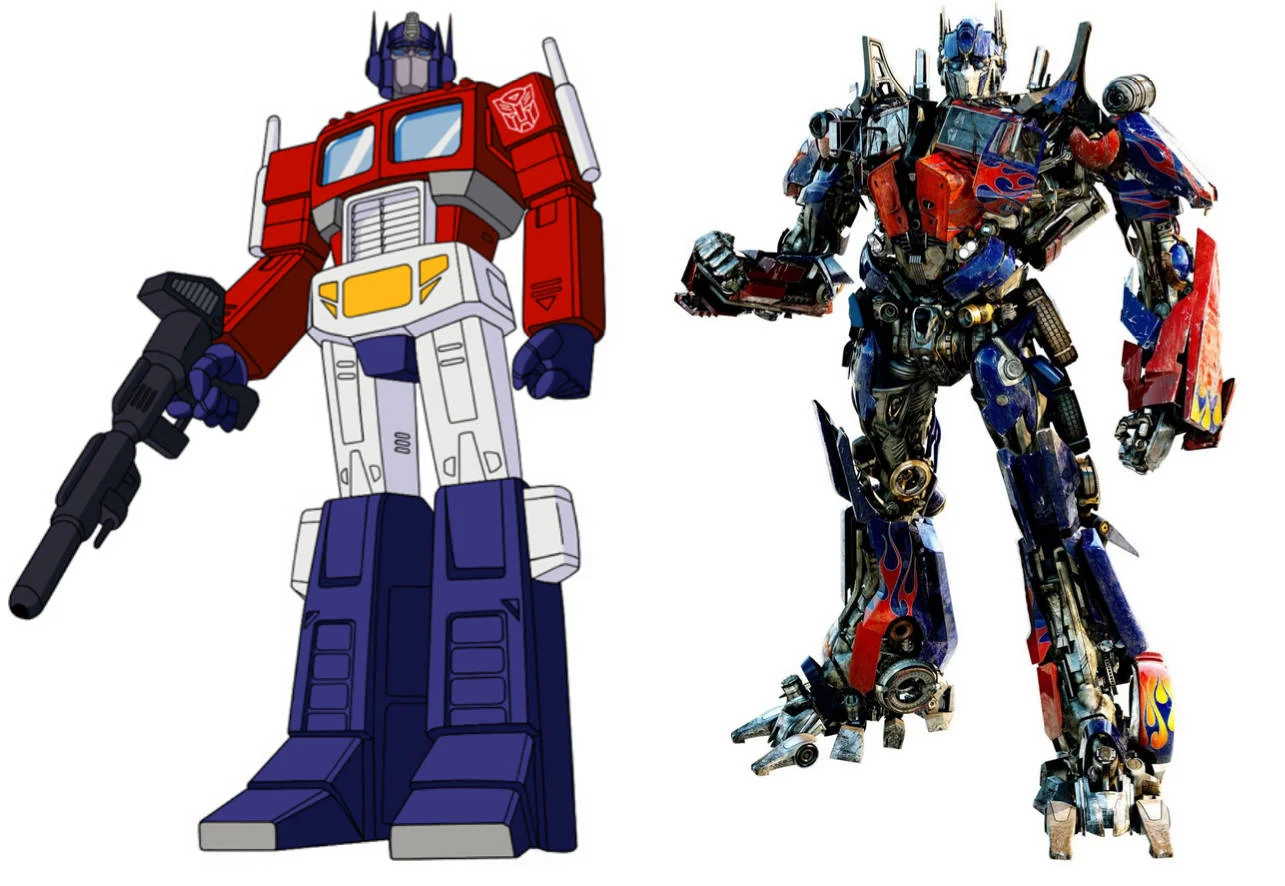
Optimus Primeʼs appearance is modeled after the classical male physique, with “the windows as pectoral muscles and front grill as abdomen” resembling that of six-pack abs, conforming to “the stereotypes of the muscular hero of American popular entertainment” (Wilson). This mechanical version of the idealized male body exudes hypermasculinity, emphasizing a sense of strength and dominance, attributes that accentuate the characterʼs role as a military leader. These characteristics have become a staple of the character, remaining through multiple iterations over the years, affirming that this is a vision the franchise wants to promote and preserve (see fig. 1). Optimusʼs color scheme, a deep shade of red and blue, is typical of male Transformers, as opposed to the generally more brightly colored female characters. Itʼs akin to that of the male versus female clothing section: the former being mostly neutral tones and the latter more diverse and bright in terms of colors. The masculine nature of the character is further enhanced by his alternate mode, a semi-truck, connoting a masculine way of life of rugged labor and independence. Moreover, the fact that the good guys of the franchise mostly transform into automobiles not only reflects the deep-rooted American cultural link between cars and masculinity, but also the deliberate choice to appeal to masculine ideals.
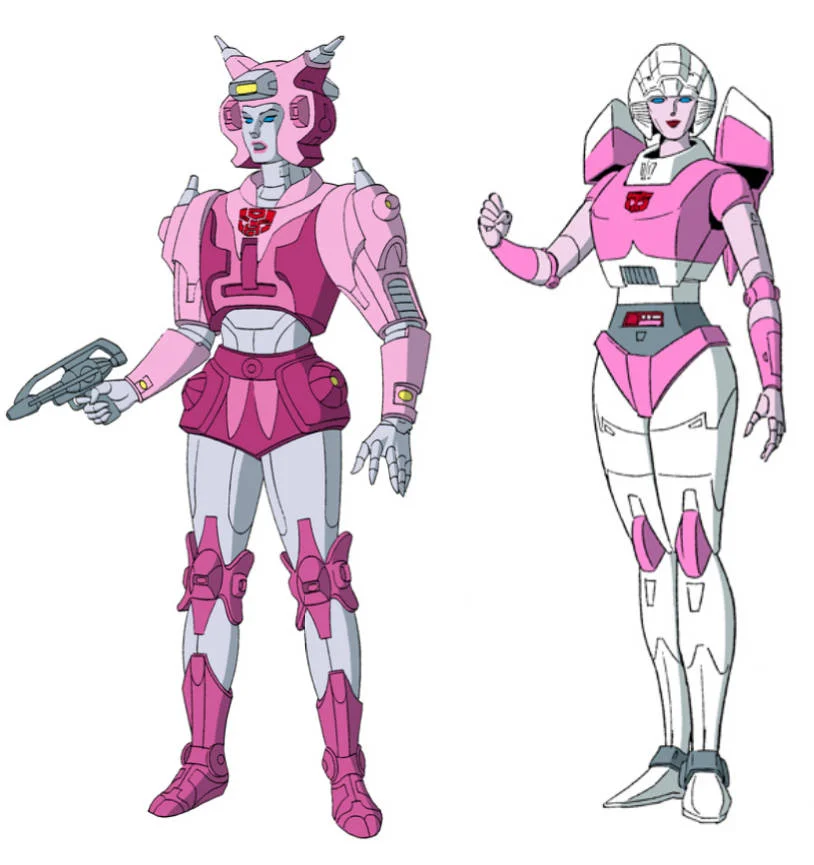
The design philosophy of Transformers characters has remained largely the same over the years, solidifying a strict male/female dichotomy. As the first animated media of the franchise, The Transformers (1984–1987) laid down much of the foundation for Transformers character design. Its designs are colloquially dubbed the “Generation 1” or “G1” designs. The cartoon series featured the first female Transformers, whose designs sharply contrast with their male counterparts: they have slim arms and a curvy body shape, as opposed to the more bulky and angular male characters (see fig. 2). Their body proportions resemble that of a human female figure, with a more protruding chest catering to the male gaze. This is a pattern that will continue to plague the franchise throughout the years, where the designs of female characters are defined by what is considered attractive to heterosexual men, conforming to heteronormativity where it is assumed that a woman is only attractive based on her desirability to a man. The need to give characters gendered characteristics persists even for characters who are identical in body type. To distinguish their genders, female characters are given makeup—colored lips and long eyelashes—whereas male characters have facial hair similar to that of a goatee. Notably, the two main female leads of the franchise, Elita One and Arcee, happen to both be pink (see fig. 2). The traditionally feminine colour scheme further reinforces the charactersʼ femininity and ensures that they can be easily identified as female even by those without any prior knowledge about Transformers. These signifiers of gender, conforming to heteronormative beauty standards and gender stereotypes, are designed to make these characters appear less alien, and thus more relatable and familiar to the audience.
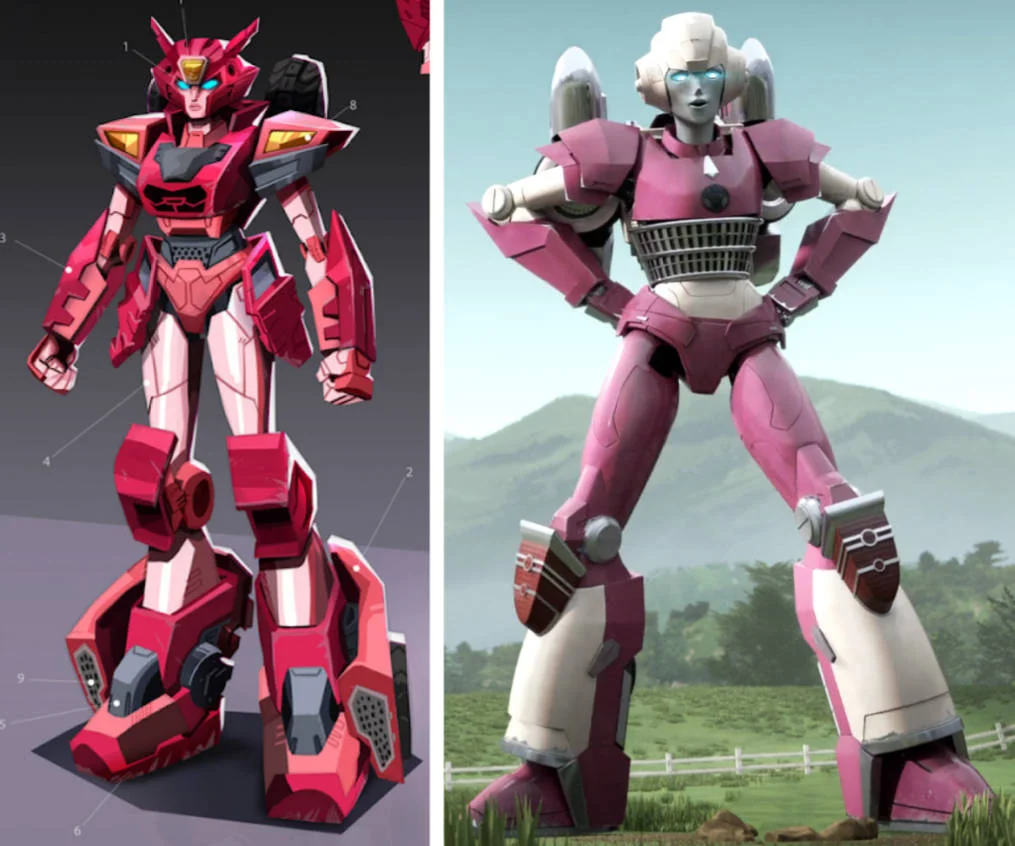
The construction of female Transformers in the image of an idealized female figure creates what Cox-Palmer-White, researcher of gender theory and science fiction, calls “a persistent image of woman as [an] assemblage” of feminine traits. The new, G1-inspired redesigns of EarthSpark aims to rectify this by incorporating traditionally masculine features into the originally hyperfeminine designs. In EarthSpark, Elitaʼs design is given more kibbles like the pads around her lower leg, making her appear bulkier than her G1 counterpart (see fig. 3). Arceeʼs redesign takes a similar approach, with the angular shoulder pads giving her a more muscular look. However, simply giving a female character a more masculine design (and vice versa for male characters) only gives the illusion of subversion to the gender binary. As Cox-Palmer White contends, any attempt to subvert the “gender assembly” still operates within the logic of gender essentialism, ultimately remaining as “a working, functioning component” of the gender binary. As an alien race of mechanical beings that reproduces asexually, Transformers should be freed from the “mother-child assemblage” as well; there is no biological justification for the characters to have sexual dimorphism or really any sexual characteristics at all (Cox-Palmer-White). And yet, their designs are still deliberately divided into male and female, pointlessly gendering/sexualizing a species that has no need for gender or sex. This choice is made simply because it is the path of least resistance: itʼs both easier to write and easier to accept. Rather than risk alienating the audience by challenging social conventions, it is far safer to create a mirror image of gender norms already familiar to most. Nonetheless, Transformers offer a unique opportunity to question what traits we consider so fundamentally human.
This invites a closer examination at how human gender presentation—something that is fluid and ever-shifting—is translated into the rigid physical bodies of Transformers. As researcher of contemporary literature and culture Kaye Mitchell observes, “the body [is] viewed as [a] locus of information and identity,” with gender expression being one of the first pieces of information conveyed to the audience through character design. It follows then that the strict division of nonhuman characters into male or female based on gender expression implies that gender expression and gender identity are one and the same. By extension, with gender presentation physically encoded into their body, the designs of Transformers reflect the cisnormative assumption that oneʼs gender identity ought to correspond to their sex assigned at birth. This raises a critical question: How would a Transformer who operates outside of the male-female binary look like? EarthSpark offers an answer in Nightshade, the first non-binary Transformers character.
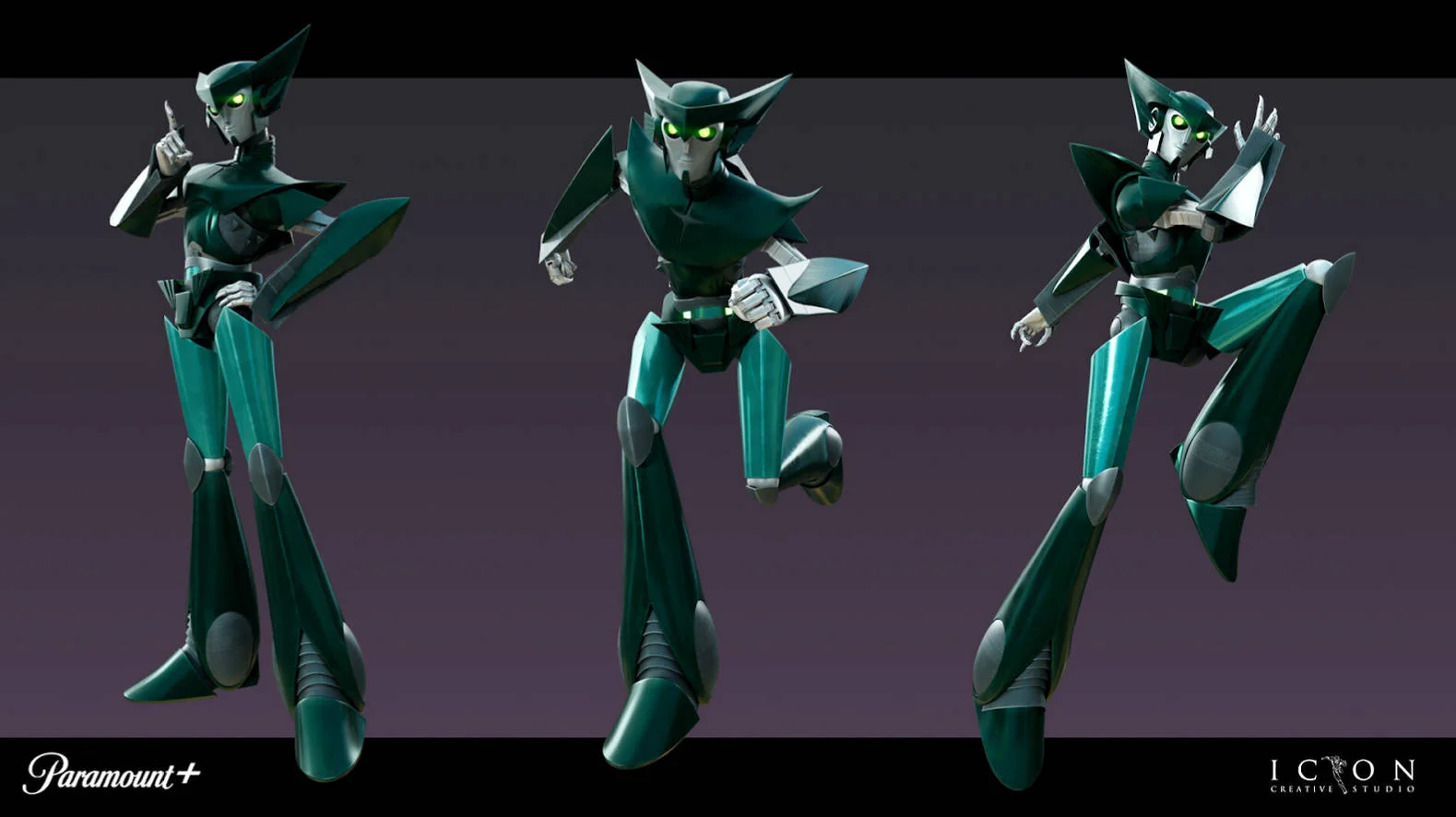
Non-binary is an umbrella term that encompasses “all gender identities where the person identifies as neither fully male nor female,” recognizing the fluidity of gender as a spectrum (Lacey). Many, but not all, non-binary people prefer to present androgynous, as androgyny is often perceived as “in-between or ambiguously gendered” (Charlie McNbabb qtd. in Lacey). However, androgyny does not mean complete neutrality. In Queerness in Play, games studies researcher of gender and sexuality Meghan Blythe Adams asserts that androgyny “typically centers thin, able-bodied masculinity as the seemingly ‘neutralʼ state of being”, which positions femininity as deviation. This means that when it comes to designing an androgynous character, intentionally avoiding gendered characteristics tends to result in a masculine-leaning character. In contrast, Nightshadeʼs design leans more feminine in silhouette, with a slender build and smooth, curvy plating (see fig. 4). These feminine traits are balanced out by the kibble on their chin resembling facial hair and the flat chest, which are traits traditionally reserved for male Transformers. While Nightshadeʼs design succeeds as an androgynous design, it remains inevitably constrained by the conventional understanding of masculinity and femininity.
In video games and TV shows, if there is only one non-binary character, that character often becomes an overarching representation of all non-binary people. Despite gender expression being separate and distinct from gender identity, androgyny is commonly used as a shorthand for non-binary identity. Complicating matters further, Cox-Palmer-White writes that:
“Gender appears to be equal parts authenticity and performance — it forms part of an identity that can be real and meaningful to us and yet it also represents an almost unbearable weight of expectation.”
Therefore, it is important to scrutinize the representation of non-binary characters as exclusively androgynous. Jamie Stenvall, a scholar of Game Development and 2D Graphics, finds that non-binary characters generally fall into two categories: nonhumans and/or androgynous. Although Nightshade is both, they are not the only non-binary character, as EarthSpark features another non-binary human character who is more feminine-presenting. The showʼs inclusion of non-binary characters with different gender expressions is commendable for normalizing and validating non-binary people of all gender expressions. Nevertheless, it is rather ironic that the non-binary identity remains tethered to the binary. As Šporčič explains, non-binary as a label “[owes its] existence to the binary division . . . or [else it] would not have been able to be positioned [as] the middle ground” between male and female. Consequently, any attempt to subvert the gender binary must still operate within the norms understood by the majority, ultimately reinforcing the heteronormative, cisnormative power structures that continue to shape queer representations in fiction.
Part II. Queer Representation in Transformers: EarthSpark
Although Transformer characters were originally constructed to align with the gender binary, there remains an inherent queerness in the very concept of shapeshifting robots. A defining trait of the Transformers as a race of autonomous robotic organisms is their ability to freely shift between their robot mode and alternative mode (commonly shortened to “alt mode”). Most transform into vehicles, namely cars, motorcycles, and jets. This fluid transformation exemplifies what Mitchell refers to as the “radical” representations of bodies as hybrid and ever-shifting in science fiction. Writers and designers who sought to explicitly introduce queerness into the Transformers franchise—such as through the character of Nightshade—often overlook the fact that Transformers has been queer all along. As such, analyzing Nightshadeʼs portrayal in EarthSpark reveals how queerness in media can emerge both intentionally and unintentionally, in ways that are explicit as well as implicit.
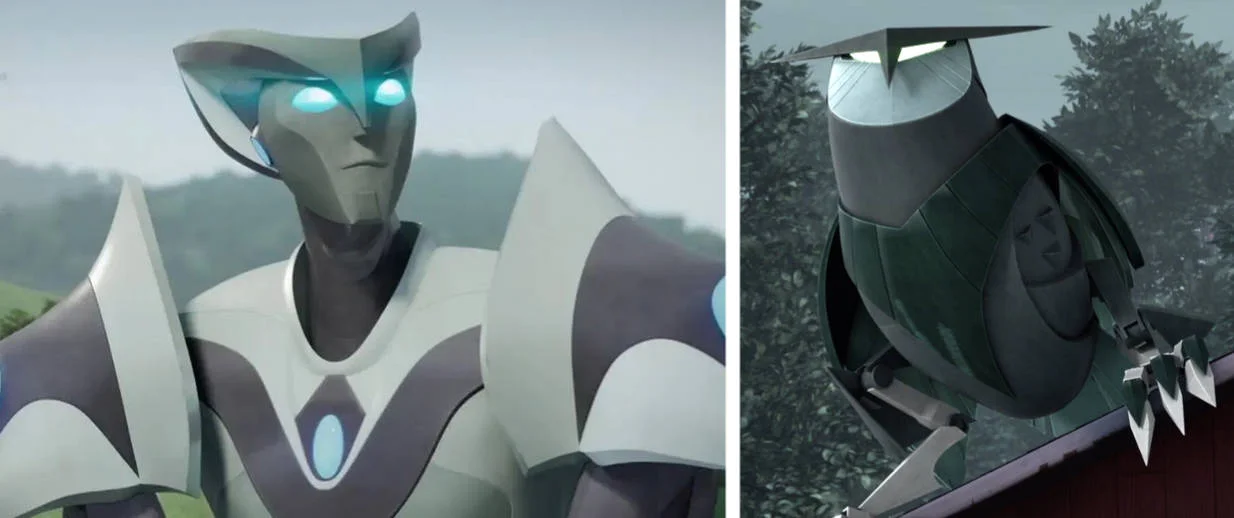
How a Transformer obtains an alt mode varies across continuities. In EarthSpark, Terrans—new Transformers born on Earth—are born without alt modes. The show places great emphasis on selecting the “right” alt mode, with each Terran having a dedicated episode about finding their own. In the episode “Missed Connection”, Nightshade, a Terran, professes that they “see no need for” an alt mode, feeling “sufficient” as they are (see fig. 5). By the end of the episode, they realize that an alt mode does not “enhance” who they are, but rather, it is an “extension” of oneself. Inspired by sentry owls from the in-universe fictional novel Winged Sentinel, Nightshade takes on the alt mode of a green owl (see fig. 5). Rather than a disguise, which is the traditional reason Transformers adopt an alt mode based on Earth vehicles, Nightshadeʼs alt mode expresses who they already are and who they want to be moving forward: to be a guardian and protector. This rejection of normative expectations makes Nightshadeʼs story a fundamentally queer narrative about forging a path that defies dominant cultural norms. Moreover, their journey of self-discovery mirrors the experiences of many transgender individuals who come to understand their identity as something that has always been a part of them. Just as Nightshade draws inspiration from a fictional character in shaping their presentation, many trans and queer people find affirmation in characters who help them recognize their own identity or orientation. Choosing an alt mode, much like adopting a new name or label, is a deeply personal and powerful choice, revealing the very concept of Transformers as transforming robots to be undeniably queer.
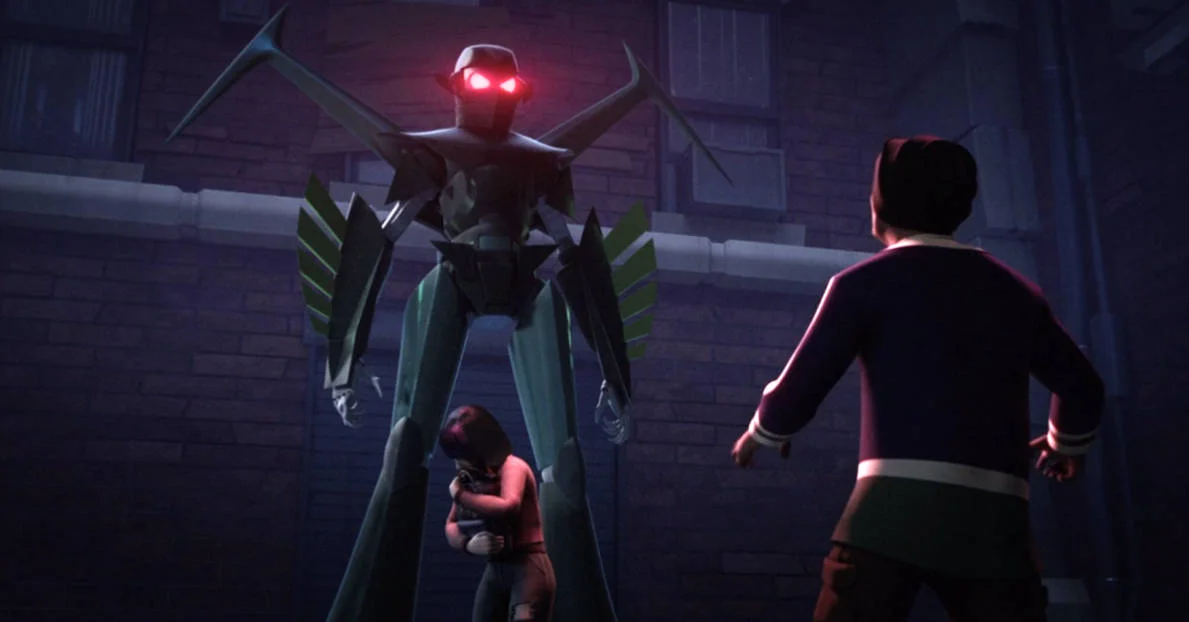
Non-vehicle alt modes are a minority in Transformers. What makes Nightshadeʼs alt mode even more untraditional is the way that it was obtained—not by scanning an actual owl, but rather an owl statue in a cemetery. This is a nod to Nightshadeʼs original alt mode early in production, when they were meant to take on the form of a gargoyle, a fantastical and bestial monster inspired by grotesque statues in architecture (Nickelodeon). There has been a long association between queerness and horror culture, dating back to old Hollywood horror films with their queer-coded villains and monster characters, as observed by gender and queer studies researcher Adharshila Chatterjee. Queer people, especially trans people, have long been labeled as monstrous because their existence threatens to destabilize the heterosexual and cisgender majority. In a later episode, “Home, Part 1”, Nightshade wanders around Philadelphia at night, with their eyes being inexplicably red (Figure 6). Their ominous, evil-looking presence in this particular episode is a set up for the plot twist that they are actually the hero who saves the day. However, this doesnʼt excuse the fact that, whether intentional or not, these horror elements directly play into the queer monster trope. The perceived foreignness and supposed evil nature of monster characters render them deviant and threatening in the eyes of normative culture. As such, they become vehicles for projecting the fear of the “other”, a role often imposed on queer people by a society that demands homogeneity and conformity.
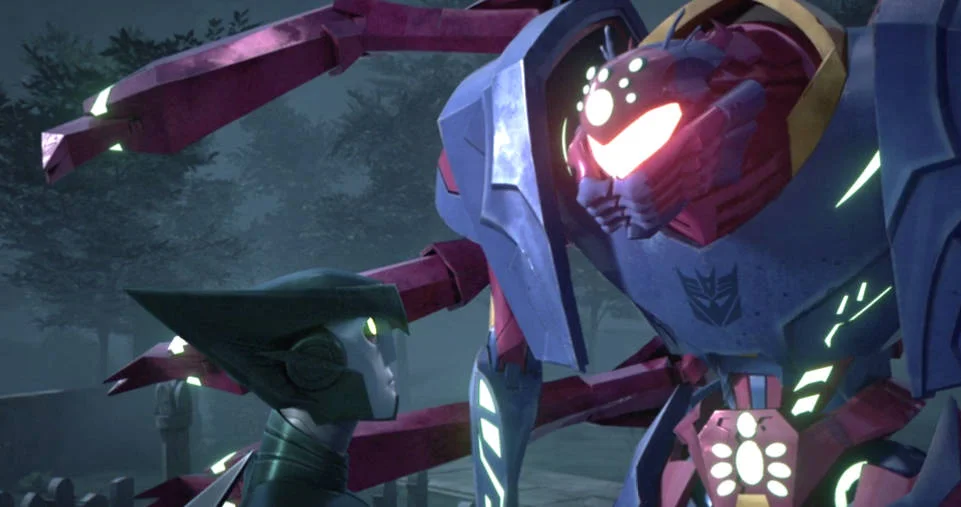
The alienation of the queer monster is further explored in the episode “Missed Connection” through the interactions between Nightshade and Tarantulas; their story reclaims the imagery of perceived monstrosity and deviance. The episode opens with Nightshade feeling isolated from their siblings, lamenting that they are treated as though they are “speaking another language.” This prompts Nightshade to embark on a solo adventure, during which they encounter Tarantulas, an outcast in hiding who hopes to develop a hologram projection that can allow him to pass as a human and live in peace (see fig. 7). The two bond over their shared sense of alienation and their mutual love for science. Tarantulasʼ frustration at needing to disguise himself for safety resonates strongly with the experiences commonly faced by non-binary and transgender individuals, who are often compelled to suppress parts of their identity for fear of backlash or discrimination. Although “Western societies do appear to be supportive of the idea of ‘being oneself,ʼ” anyone perceived as non-normative—as is the case of queer people—inevitably attracts “the questioning of the legitimacy of oneʼs identity, mocking, scorn and even violence” (Šporčič). The implicit queer subtext of Nightshade and Tarantulasʼ experience of being othered and misunderstood by those around them, combined with the theme of hidden identity, ultimately underscores the emotional reality of navigating a world that is hostile to anyone deemed deviant.
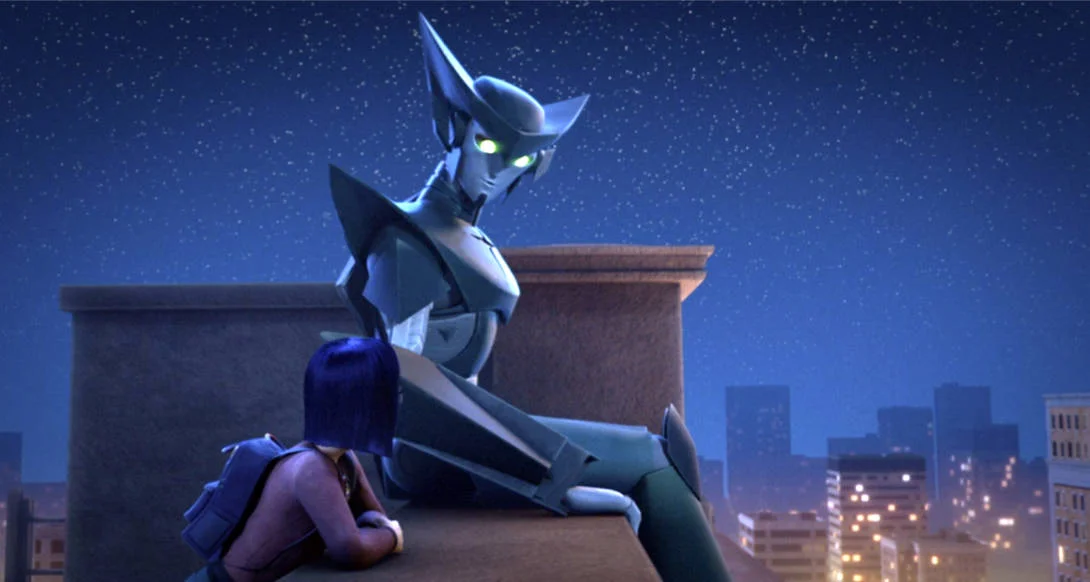
The bond between Nightshade and Tarantulas is one of queer solidarity and resilience, a theme that becomes even more explicit in the episode “Home, Part I”, where Nightshade connects with Sam, a human character whom they saved from a potential mugging (Figure 8). Sam, who happens to be non-binary, expresses thanks to Nightshade and shares that while the world can be a dangerous place, they feel safe when theyʼre with other non-binary people (“Home, Part I”). Having been introduced to the term “non-binary”, Nightshade remarks that it is a “wonderful word for a wonderful experience” and embraces the label for themself. This moment is one that explicitly represents the lived experience of many trans and queer people: the eye-opening moment of discovering a word that describes the thoughts and feelings you havenʼt been able to put into words, and the profound sense of recognition that comes from finding others who understand and share your experience. Nightshade and Samʼs exchange also captures the social isolation experienced by queer individuals that fosters a deep sense of unity within queer communities, which form out of a necessity for a safe space to exist beyond the confines of a predominantly heteronormative and cisnormative society.
When discussing LGBTQ+ characters in media, the words “good” or “bad representation” are frequently used. Such binary language is limiting and counterproductive in conversations about queerness as a spectrum that challenges binary thinking. Hence, I will instead be borrowing the terminology of scholar Lauren Lacey to evaluate queer representation in terms of effectiveness and productivity. Through the direct inclusion of the term “non-binary” and Nightshade introducing themselves with “they/them” pronouns on multiple occasions, EarthSpark makes their identity undoubtedly clear. The show proves to be effective in creating a queer narrative, with Nightshade and Sam being an explicit representation of solidarity among the trans community, as well as through the implicit queer-coding of Nightshade and Tarantulas in their conversations about identity and belonging. However, there is more that EarthSpark couldʼve done when it comes to queer representation. While non-binary as a term is a valid identity and source of pride for many, any kind of label inevitably comes with a baggage of expectations. An early concept of Nightshade indicates that they identified simply as “Terran”, which was later changed in favor of labeling the character as explicitly non-binary (Nickelodeon). In doing so, EarthSpark missed a unique opportunity to fully transcend human gender frameworks and explore gender as a malleable social construct. Indeed, sci-fi narratives have the perfect opportunity to engage in the construction of “alien...concepts of self and other” through the creation of characters whose gender identity deviates from that of the human experience (Cox-Palmer-White). Perhaps it would have been more productive for queer representation overall to have a character who is indisputably queer and do away with gender essentialism. But non-binary is the easier approach: it is easier to write and easier for the showʼs young audience to digest. Underpinning this decision is the constraint of profit-driven entertainment, which sees a need to reintroduce familiarity in fear of losing the predominantly cisgender and heterosexual audience. Transformers: EarthSpark has the potential to do something more radical, more transformative, but ultimately chose the safer path in order to appeal to the widest audience possible.
Part III. The Influence of Consumers on Media Production
Nowadays, with a more diverse cast of characters in terms of gender and design, the Transformers franchise has come a long way from its origin as an overwhelmingly androcentric franchise. It is good progress, but it is not enough. A study published in 2013 reports that out of the thousands of Transformers characters, only 138 are female (William). The Aligned Continuity, another universe in the franchise, has attempted to offer an in-universe explanation for this disparity by stating that all Transformers are modeled after The Thirteen, the first Transformers who are essentially demigods. Of The Thirteen, only one, Solus Prime, is female (Robson). This divine-creation myth only further insists upon the male/female binary. By framing Solus Prime as the singular “original” woman, the narrative positions her as an exception, implying that women are inherently a sub-species and that men are the default. It also frames any identity outside the gender binary as deviant and abnormal. Instead of female and trans characters simply existing “just because”, this insistence on having to justify their presence reveals the franchiseʼs ongoing struggle to move beyond androcentrism and the gender binary.
The push for more diverse characters in Transformers appears to be an effort coming from the creative teams behind the stories, rather than from executive mandates. According to Mae Catt, one of the story writers and editors of EarthSpark, Nightshade was “always conceived as nonbinary” by the showʼs creator. Catt also confirms that there are “many queer team members working behind the scenes” to ensure that Nightshade is a “compelling character”, with help from “executives, boards team, and DEI consults along the way” (Catt). Many writers have tried to increase female representation by genderbending existing male characters, but this has faced backlash from the executive level at Hasbro, with certain male characters being off-limits. Particularly in EarthSpark, the writers had wanted to include a genderbent female version of the character Thundercracker, but were told they couldnʼt, so another female character was included instead (Mae Catt at TFNation 2023). Similarly, in Transformers: Cyberverse, story editor Randolph Heard was told that his idea for a female version of the character Lugnut had to have a different name, as Hasbro preferred to keep “Lugnut” as male (TFWiki). The pressure to keep the major characters of the franchise as male in order to ensure relatability for male audiences not only demonstrates the prevalence of androcentrism, but also a clash between creative visions and corporate motives.
Beyond the creatives and the executives, there is a third underlying force shaping the worldbuilding of Transformers—the fans. In general, the production teams behind the franchiseʼs shows and comics tend to be relatively aware of the fandom culture surrounding their media, with the EarthSpark Season 1 production team having a “fan art wall” at Nickelodeon Animation Studio (Transformers-earthspark). There are also many instances of popular Transformers fandom headcanons, personal interpretations of the source material, being adopted into official media. This intersection between media production and consumers who actively engage in said media through the production of fan work is what researcher of media, popular culture, and participatory culture Henry Jenkins coins the “convergence culture.” Within convergence culture, fans who are not satisfied with the existing content—in this case, LGBTQ+ fans who are dissatisfied with the lack of queer characters in Transformers—would in turn produce their own derivative content. As Jenkins explains:
“Whatever we do with our media—what we read, watch, listen to, participate in, create, or use—pushes well beyond what is predicted, produced, or programmed by corporate media organizations. Consumers are using the grassroots channels offered by digital and mobile technologies to assert their own control over cultural flows.”
Canon is not a final verdict, and characters are not static. Through the queering of Transformers, queer fans are able to carve out a space for themselves in a franchise that originally was not created with them in mind. Shipping culture—where fans enjoy and support (oftentimes non-canon) romantic relationships through fan art, fan fiction, and social media engagement—is especially prevalent in the Transformers fandom, with many popular pairings involving queer reinterpretations of characters. This arises not only from the lack of queer characters to begin with, but also from the inherent queerness embedded into the idea of transforming robots—an aspect that the franchise, rooted in heteronormativity and cisnormativity, had failed to recognize in its own worldbuilding. Queer fans, on the other hand, are able to decode this underlying queerness and materialize the subversive potential of the world of Transformers, thereby challenging the normative structures baked into the fabricate of this franchise.
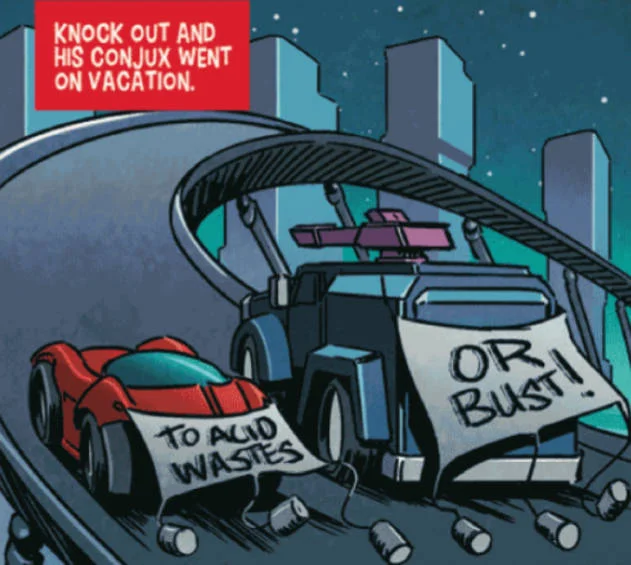
It might be tempting to view the queering of Transformers by queer fans as a purely positive thing. However, as Jenkins points out, fanwork both “supports as well as subverts corporate control” because at the end of the day, they are unpaid promotional content that benefits the franchise (Jenkins). Yes, it is a labor of love, but it is still free labor nonetheless. Fans are arguably the bloodline of any franchise, as they offer time, energy, and creativity, all without the intention of seeking monetary compensation. More importantly, their passion fuels the demand for more merchandise and new content, making them an essential component of the capitalist system within which media production operates. Companies understand this dynamic and they exploit it; fans are free marketing. But fans are not just cash cows—they know how to weaponize their labor as leverage to demand the corporations to meet their needs and wants. According to Elena Maris, whose research is concerned with the interactions between media industry and their audiences, online forums and social media have enabled LGBTQ+ fans “to communicate their desire for alternative narratives directly to producers”, allowing for what she calls “queer hacks” of mainstream entertainment. An example of this happening in Transformers is the romantic pairing of Knock Out and Breakdown, two male Transformers, becoming a canonized couple in the IDW comics due to the high popularity of the pairing among fans (see fig. 9). As a result of the activity of its LGBTQ+ fanbase, Transformers, a franchise originally devised in heteronormative and cisnormative values has increasingly begun to be read and written as queer.
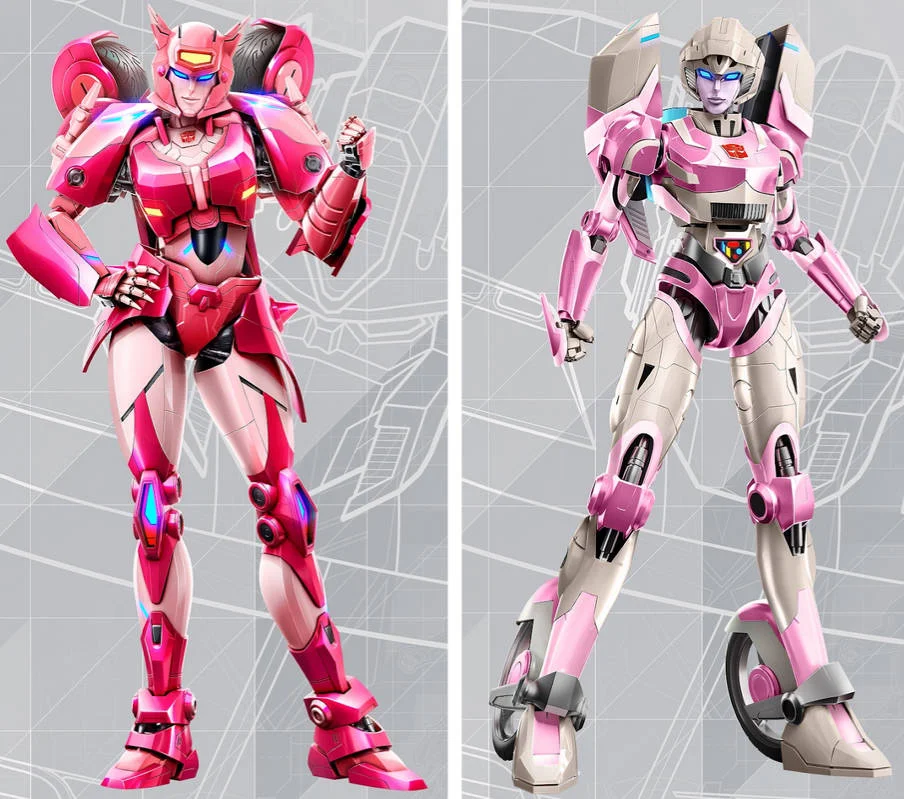
Still, as of 2025, no queer characters other than Nightshade have appeared in any media of the Transformers franchise outside of the comics. The inclusion of a single trans character does not necessarily serve as an indication that the franchise has fully moved away from its conservative origin. As Šporčič observes, science fiction goes through cycles in which “a handful of relatively courageous ventures” exploring non-normative gender experiences are almost always “immediately” followed by a return to the gender binary and gender essentialist approach. In the case of Transformers, the newest “evergreen designs”, standard character designs not tied to any particular canon media, are heavily based on the original Generation 1 designs and carries with them the same gender issues that have persisted since the inception of the franchise. This return to the old suggests a continued preference for nostalgic familiarity over progressive change.
On the contrary, EarthSpark makes a conscious attempt to move away from the franchiseʼs conservative origin through character designs as well as its themes. As stated in the showʼs production bible, EarthSpark represents a progressive, modern vision for Transformers:
“Like many of our young viewers, the Terrans are figuring out who they want to be and how they fit in. Our show will lean into these questions, exploring the themes of identity, contribution to community, and the idea that what you are doesnʼt define who you are [sic].”
On one hand, executivesʼ willingness to greenlight this vision and include a character like Nightshade reflects societyʼs growing acceptance of LGBTQ+ people and broader acknowledgement of the values of diversity and inclusion. On the other hand, it is merely capitalism adapting to the condition of its time—recognizing a shift in consumer demographics and concluding that it is now more profitable to at least pay lip service to queer rights than to remain silent. In commenting on queer representation, Šporčič maintains that “representation in the fictional world signifies social existence; absence means symbolic annihilation.” This means that at the bare minimum, representation is an acknowledgement of the existence of marginalized groups. Though perhaps more significantly, it is an affirmation that these groups are economically valuable consumers—worthy of being seen, included, and marketed to. However, there is no doubt that increased LGBTQ+ visibility, even just through the explicit mention of terms like “non-binary” in EarthSpark, can have real and lasting impacts. Queer representation has the power to address “hermeneutical injustice”, a situation in which “a person has no way to describe their experience because the conceptual frame doesnʼt exist yet due to their stigmatised or disempowered identity” (Fricker 2007, as qtd. in Šporčič). Furthermore, cultural norms around gender and sexuality can have a profound influence on scientific research. Steward illustrates this with the example of homosexuality, which “has been deemed ‘objectivelyʼ as a crime, a sickness, and an acceptable identity at different points in time” (Steward 2017, as qtd. in Šporčič). Therefore, even when shaped by capitalist motives, queer representation remains meaningful nevertheless. It is especially important for childrenʼs media like EarthSpark to offer productive queer representation, as such content plays a vital role in shaping young audiencesʼ understanding of identity, acceptance, and most importantly, empathy.
At its core, Transformers exists to make money. After all, capitalism demands profit, and profit drives creative decisions. Corporations like Hasbro have a vested interest to appeal to the widest audience possible, which translates to creating narratives that conform to our largely herernormative and cisnormative society. This means that EarthSpark is the exception, not the rule. The show exists in its current form because Hasbro believes that its themes would not only resonate with kids, but also be deemed appropriate by parents, who are ultimately the ones with purchasing power. Or, at the very least, itʼs what the company once believed. Though it is beyond the scope of this paper, it is important to acknowledge that the inclusion of Nightshade in EarthSpark has sparked major controversy and criticism from mainstream media. More recently, Hasbro appears to be neglecting the project; the show received very little promotional content for its last two seasons and the toyline experienced poor distribution and potential cancellation. This uncertainty underscores the fragile state of queer representation in mainstream media.
It often seems inevitable that the construction of fictional worlds would end with a mirror image of our own world, replicating structures and values that continue to marginalize those who are the most vulnerable. And yet, change is possible. What does it mean for todayʼs media landscape that Transformers was able to shift from an androcentric to a more queer and inclusive franchise over the span of more than 40 years? The answer is that progress is neither guaranteed nor linear. At a time when conservatism is seemingly on the rise, representation alone cannot dismantle systemic violence against the queer community—but it plants seeds. And as long as fans, audiences, and creators continue to push for more nuanced portrayals of queer experiences, the media landscape can—and will—continue to shift. After all, we have the right to demand more from life than this injustice.
Works Cited
Adams, Meghan Blythe. “Bye, Bye, Birdo: Heroic Androgyny and Villainous Gender-Variance in Video Games.” Queerness in Play, edited by Todd Harper, Meghan Blythe Adams, Nicholas Taylor, 2018, pp. 147-163.
Catt, Mae [@maecatt]. “Hey there, @megatronsimp! Thank you for your heartfelt sentiments. I just wanted to reply…” Tumblr, 5 Aug. 2024, www.tumblr.com/maecatt/758033932336922624/hey-there-megatronsimp-thank-you-for-your.
Catt, Mae. “Earth is Where the Spark is.” TFNation 2023, 12 Aug. 2023, Hilton Birmingham Metropole Hotel, Birmingham, UK.
Chatterjee, Adharshila. “‘Fantastic Bodies And Where To Find Themʼ: Representational Politics Of Queer Bodies in Popular Media.” Special Focus on Animal Studies, Rupkatha, vol. 8, no. 3, 2016. Rupkatha Journal on Interdisciplinary Studies in Humanities, doi: 10.21659/rupkatha.v8n3.22.
Cox-Palmer-White, Emily. The Biopolitics of Gender in Science Fiction: Feminism and Female Machines. 2021. Routledge, doi:10.4324/9780367691011.
Jenkins, Henry, and Mark Deuze. “Editorial: Convergence: Culture.” Convergence: The International Journal of Research into New Media Technologies, vol. 14, no. 1, Feb. 2008, pp. 5-12. Sage Journals, doi:10.1177/1354856507084415.
Lacey, Lauren. “‘A Checkbox on a Character Sheetʼ: Nonbinary Gender Representations in Video Games”. The IJournal: Student Journal of the Faculty of Information, vol. 8, no. 2, Apr. 2023, doi:10.33137/ijournal.v8i2.41032.
Maris, Elena. “Hacking Xena: Technological Innovation and Queer Influence in the Production of Mainstream Television.” Critical Studies in Media Communication, vol. 33, no. 1, Informa UK Limited, Jan. 2016, pp. 123–37. Taylor & Francis, doi:10.1080/15295036.2015.1129063.
Marshall, Laine. Animating Gender: Conflicting Narrative and Character Design in Gravity Falls. 2024. Chapman University, Masterʼs Thesis. Chapman University Digital Commons, doi: 10.36837/chapman.000596.
Merrick, Helen. “Gender in Science Fiction.” The Cambridge Companion to Science Fiction. Edited by Edward James, Farah Mendlesohn, Cambridge University Press, 2003, pp. 241-252.
Mitchell, Kaye. “Bodies That Matter: Science Fiction, Technoculture, and the Gendered Body.” Science Fiction Studies, vol. 33, no. 1, 2006, pp. 109–28. JSTOR, www.jstor.org/stable/4241411.
Nickelodeon. “Transformers Earthspark Series Pitch Bible.” Internet Archive, archive.org/details/ewx247.
Robson, Justina. Transformers: The Covenant of Primus. Becker & Mayer, 2013.
Šporčič, Anamarija. “The (Ir)Relevance of Science Fiction to Non-Binary and Genderqueer Readers.” ELOPE: English Language Overseas Perspectives and Enquiries, vol. 15, no.1, 2018, pp. 51-67, doi:10.4312/elope.15.1.51-67.
Stenvall, Jamie. “‘ARE YOU A BOY OR A GIRL?ʼ non-binary character design in gaming.” 2021. University of Skövde, Bachelorʼs Thesis. Digitala Vetenskapliga Arkivet.
TFCon. “Transformers Ratchet was Originally Going to be Female.” YouTube, 20 Aug. 2018, www.youtube.com/watch?v=UQPPVOkOxvE.
TFWiki. “Clobber (Cyberverse).” Transformers Wiki, tfwiki.net/wiki/Clobber_(Cyberverse). tfwiki.net/wiki/Clobber_(Cyberverse). Accessed 3 June 2025.
Transformers-earthspark [@transformers-earthspark]. “Fan art wall.” Tumblr, 16 May 2024, www.tumblr.com/transformers-earthspark/750653718336274432/fan-art-wall.
Underwood, David William. American socio-politics in fictional context: transformers and the representation of the United States. 2013. University of East Anglia, Masterʼs Thesis.
Wilson, D. Harlan. “Technomasculine Bodies and Vehicles of Desire.” Extrapolation, vol. 53, no. 3, Jan. 2012, pp. 347-64. Liverpool University Press, doi:10.3828/extr.2012.19.
“Home, Part 1.” Transformers: EarthSpark, created by Nicole Dubuc, Dale Malinowski, and Ant Ward, season 1, episode 17, Entertainment One, Hasbro Entertainment and Nickelodeon Animation Studio, 2023.
“Missed Connection.” Transformers: EarthSpark, created by Nicole Dubuc, Dale Malinowski, and Ant Ward, season 1, episode 13, Entertainment One, Hasbro Entertainment and Nickelodeon Animation Studio, 2023.
Images Cited (In Order of Appearance)
“Optimus Prime.” Transformers.kiev.ua, www.transformers.kiev.ua/g1/optimusprimeg1.html. Accessed 5 June 2025.
“Here a few selects.” TFW2005, 7 Oct. 2012, www.tfw2005.com/boards/threads/cgi-renderings.674876/.
“2D/3D art The most accurately coloured G1 animation models online!” The Allspark, 4 Oct. 2021, www.allspark.com/home/threads/the-most-accurately-coloured-g1-animation-models-online.301/.
ArtCup. “Transformers Earthspark Concept Art.” ArtStation, www.artstation.com/artwork/VyEkYg. Accessed 5 June 2025.
“Decoy.” Transformers: EarthSpark, created by Nicole Dubuc, Dale Malinowski, and Ant Ward, season 1, episode 8, Entertainment One, Hasbro Entertainment and Nickelodeon Animation Studio, 2023.
Contrerash, Sebastian. “NightShade from Transformers EarthSpark.” ArtStation, www.artstation.com/artwork/5vok5A. Accessed 5 June 2025.
“Age of Evolution, Part 2.” Transformers: EarthSpark, created by Nicole Dubuc, Dale Malinowski, and Ant Ward, season 1, episode 10, Entertainment One, Hasbro Entertainment and Nickelodeon Animation Studio, 2023.
Scott, Mairghread (Writing), Corin Howell (Art), Thomas Deer (Colors), Tom Long (Letters). “Choose Me.” The Transformers Holiday Special (23 Dec. 2015), IDW Publishing.
Hasbro [@transformersofficial]. Instagram, 7 April 2025, www.instagram.com/p/DIJzvnWJRQj/.