Forever Tainted: The Effects of Imprisonment As Seen in Titus Kaphar's Jerome III
Summary:
One of these artworks, Jerome III (2014), examines the enduring impacts of imprisonment and the struggle to retain humanity. The symbolic use of tar and the golden hue juxtaposes the sanctity of human life with the dehumanizing reality of mass incarceration, which disproportionately affects Black men. The artwork exposes the injustice within the criminal justice system, centering the humanity of individuals whose voices have long been suppressed.
Notes:
I had a lot of trouble writing this one, but I'm really proud of how it turned out.
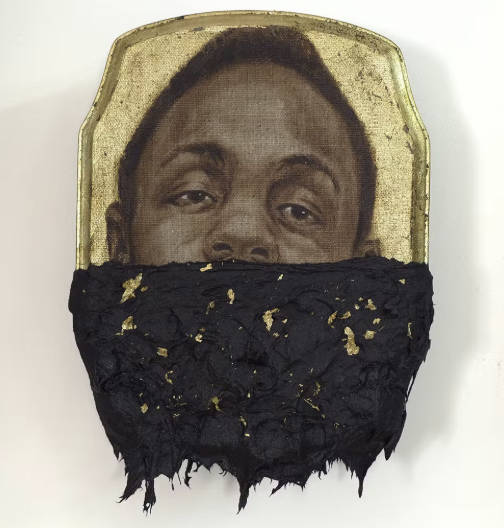
Oil, tar, and gold leaf on wood panel. 10 in. × 7 in. × 1 in.
Behind every artwork, there is an artist whose life has been greatly influenced by the institutions that govern their environment. From political cartoons to protest graffiti, art has consistently served as a medium for expressing concern regarding social issues and advocating political changes. This places art museums in a pivotal role: by choosing which works of art to display, curators hold the power to construct narratives of cultural history and educate the public about the significance of social movements (C.). Historically, the voices of African Americans have been marginalized in the art world. Although their artwork has been largely absent from such exhibition spaces, they never stopped creating. Artist Titus Kaphar is among the recent generation of contemporary Black artists who use their art to highlight topics of social injustice and celebrate the perseverance of African American identity. In his art series The Jerome Project, Kaphar painted mugshots of incarcerated men who share the same name as his father, Jerome Kaphar (Keller). One of these artworks, Jerome III (2014), examines the enduring impacts of imprisonment and the struggle to retain humanity. The symbolic use of tar and the golden hue juxtaposes the sanctity of human life with the dehumanizing reality of mass incarceration, which disproportionately affects Black men. The artwork exposes the injustice within the criminal justice system, centering the humanity of individuals whose voices have long been suppressed.
The tar obstructs the subjectʼs face, evoking a sense of lost identity while simultaneously restoring a measure of privacy to the man depicted in the painting. With his face half-submerged in tar, the subjectʼs identity remains a mystery. To the viewer, what stands in front of them is the portrait of a complete stranger. The human brain, adept at recognizing faces and reconstructing images, grapples with this ambiguity. This obscurity creates tension between the viewerʼs desire to identify the man and his wish to remain anonymous (or not). The application of tar is a forceful one, as the individual portrayed did not—could not—consent to being painted. It is symbolic of the dehumanizing nature of the prison system, where one personal identity is stripped away, becoming just another “Jerome”—a name read off a list, one body among many. Like the man in the painting, individuals are reduced to merely a number in statistics about mass incarceration and the high imprisonment rates of Black Americans. Paradoxically, while prisoners lose their individuality behind bars, their mugshots remain permanently enshrined in the public record. As is the case with the man in the artwork, his face is on full display for the world to see. Protectively, the tar disrupts this exposure, granting the incarcerated the mercy of remaining unidentified and shielding them from being tied to their criminal past.
Although tar conceals, it also preserves. The use of tar and amber has a double meaning: it symbolizes the tormenting experience of prison life while underscoring the necessity of preserving and acknowledging that reality in the public consciousness. A golden, amber color encapsulates the head fully, alluding to the imagery of fossilization by amber. This works in tandem with tar, another material known for the exceptional preservation of fossilized remains. Together, these materials create a metaphor for the physical separation between incarcerated individuals and the rest of society. This encasement represents a stasis—not only are inmates physically isolated, but they also have limited access to outside information, leaving them trapped in time. Like an insect trapped in amber, prisoners remain frozen from the moment they enter the prison system, which is why many struggle to reintegrate into society upon release. By presenting the portrait of an incarcerated Black man as analogous to that of a fossil on display, the artwork frames the topic of mass incarceration and its effect on the Black community as one worthy of study and reflection. While the voices of the imprisoned may be marginalized, this artwork serves as a means of memorializing their experiences. Further amplifying the injustices of the prison system, tar carries connotations of labor and exploitation. Its association with the fossil fuel industry—a sector dominated by profit-driven corporations—parallels the economic forces that sustain mass incarceration. The man portrayed in this painting is just one of countless individuals exploited by the prison-industrial complex, where corporations profit from prison labor and the privatization of the prison institution itself.
The materiality of tar highlights the torment and enduring impact of prison life. Initially, Kaphar intended for the amount of tar on the painting to correspond to the amount of time the man spent in prison. However, he later abandoned this idea, in acknowledgment that the influence of prison extends far beyond oneʼs sentencing (Isabella Steward Gardner Museum). The tar signifies an inescapable fate of death for whatever creature it comes into contact with. It evokes a sense of permanence; once touched, it is nearly impossible to get rid of. In the same way, prison, intended as both rehabilitation and punishment, leaves deep, lasting trauma. Like the tar marking the canvas, prison permanently taints an individual with the shadows of their past. Beyond its symbolism, the tar also alters the physical composition of the artwork. It is heavy, both in its literal weight as well as the visual weight it occupies. In contrast to the two-dimensionality of the painting underneath, the tar—representing the prison system itself—makes its presence known and unavoidable. The dripping tar near the bottom of the canvas creates a downward motion, symbolizing the burden of prison weighing and dragging the man down. Tar pitch, notorious for its slow movement, further underscores the stagnation of prison life, its long-lasting presence speaks to the enduring psychological and societal impacts of imprisonment.
Shining against the abyss of tar are flakes of gold leaf. The stark contrast between gold and black—light and dark—illustrates the perseverance of humanity against the crushing weight of imprisonment. Delicate and fragile, the gold foil sparkles against the suffocating darkness of the tar, conveying the resilience required to maintain integrity and rise above the seemingly impossible weight of incarceration. Its fragility underscores the struggles that follow imprisonment. Though oneʼs humanity may endure, the path forward is one shrouded in darkness, fraught with challenges that mirror the jaggedness of the tar. Criminal records limit employment prospects, social reintegration proves difficult, and the stigma surrounding incarceration all combine to cast a long shadow, threatening any sense of stability one manages to build—just as the tar easily fractures the delicate gold. Gold, a color traditionally associated with wealth, luxury, and success, starkly contrasts the realities of prison life. Inmates, often seen as occupying the lowest strata of society, are not afforded such notions of privilege. This dissonance serves as a sobering reminder that the disparities in wealth and opportunity do not disappear once a sentence is served. In juxtaposing the lavishness of gold to the life of an inmate it ordains, the golden color emphasizes the discrepancy of wealth in human society, where poverty and race often dictate oneʼs fate within the criminal justice system.
The subject is painted against a golden background, reminiscent of religious iconography, which restores a sense of dignity and reverence to the incarcerated individual. Kaphar replicated the style of Byzantine icons, where saints and martyrs are often depicted against a gold background on wood panels (Brooklyn Museum). This visual connection elevates the subjectʼs status, compelling the viewer to view them with dignity and empathy. The underlying religious tone invokes the concepts of forgiveness and redemption. If prison is truly meant to rehabilitate, then surely those who have served their time deserve at least the basic decency of being recognized as human beings with worth and value. The conflicting imagery—the saintly and the stigmatized—challenges preconceived notions about ex-convicts, particularly the criminal stereotype surrounding African Americans.
The artwork engages the viewer in a dialogue with the man portrayed, whose inability to respond exposes the harsh, uncomfortable truth about abuse within the prison system. When the artwork is displayed on the wall of an art museum, it is positioned at eye level with the viewer. The man looks slightly to the side, narrowly avoiding direct eye contact with the viewer as if burdened by shame. Deep shading around the eyebrows, nasal bridge, and eye bags accentuates the weariness and exhaustion etched into his expression. This invites the viewer to ponder the source of his agony. Yet, he cannot respond, for he has no mouth and no way to speak of the horrors he has witnessed. The tar, with its oppressive weight, physically silences the man, projecting a sense of unease back onto the viewer. This discomfort is amplified by the slight upward tilt of the head, which gives the impression that the man is drowning, desperately reaching out while suffocating under the denseness of the tar. As the viewerʼs gaze naturally shifts downward, the rough texture of the tar disrupts the smoothness of the painting underneath, further intensifying the unsettling tone. The subjectʼs gaze invites the reader to a conversation, only for the invitation to be revoked abruptly by the tar, forcing the viewer to confront the silencing of his voice. The man portrayed is one of many Jeromes—one of countless incarcerated individuals whose lives and stories remain absent from the national narrative. The abuse and corruption within the prison system are silenced along with their voice, leaving their suffering unspoken and forgotten.
Kapharʼs artwork gives voice to individuals who have long been marginalized, shining a light on social issues that demand urgent attention. Through its visual language, the artwork critiques the prison system for stripping individuals of their humanity while profiting from their confinement. It draws attention to the abuse and inequality within the prison system, as well as its failure to rehabilitate and instead inflict endless punishment. Our society should be built on community and mutual understanding, yet when communication breaks down, violence and cruelty take root. The dehumanization of incarcerated individuals is reinforced by a criminal justice system steeped in racial biases and disparities. The systemic racism embedded in many institutions across this country cannot be eradicated by a single decree, just as the bitter scars left by decades of slavery and racial segregation cannot be washed away. However, with artworks like The Jerome Project bringing these injustices to the forefront, capturing the publicʼs attention—if only momentarily—the hope is that a small step can create a ripple effect that may spark lasting change.
Works Cited
Brooklyn Museum. “The Jerome Project (My Loss).” Brooklyn Museum, 1 July 2015, https://www.brooklynmuseum.org/opencollection/objects/218233.
Isabella Steward Gardner Museum. “Titus Kaphar: The Jerome Project.” ISGM, https://www.gardnermuseum.org/experience/titus-kaphar-jerome-project/gallery-guide.
Keller, Bill. “Titus Kaphar On Art, Race And Justice.” The Marshall Project, 1 Feb. 2017, https://www.themarshallproject.org/2017/02/01/titus-kaphar-on-art-race-and-justice.