Hamlet Essay: Love Is a Color Wheel (And I'm Colorblind)
Summary:
Exploring the many different kinds of love in Hamlet using the color wheel theory of love. Featuring 1) the companionship and (one-sided) selfless love between Hamlet and Horatio, 2) the passionate, romantic love between Hamlet and Ophelia, which was ultimately destroyed by ludus, and 3) the romantic yet practical love between Claudius and Gertrude.
Notes:
I enjoyed writing this essay a lot and I really like how it turned out <3 The fact that I ship Hamlet/Horatio does not prevent me from acknowledging and appreciating the canon complexity of Hamlet/Ophelia ☝ This essay is pretty much my close-to-canon headcanon.
Introduction
Oh, love. One of the most common themes in writing. And a versatile one, too. From comedy to tragedy, whether itʼs enemies-to-lovers or found family, these stories will have readers on the edge of their seats when done right. In the essay Whatʼs Love Got to Do with Hamlet?, Jefferey R. Wilson claims that Hamlet is one such story where love is the source of tragedies, a statement which I wholeheartedly agree with. However, I disagree with Wilsonʼs characterization of Hamlet and Horatioʼs relationship as strictly platonic (philia). I also think the romantic love (eros) between Hamlet/Ophelia versus Claudius/Gertrude is distinctively different and deserves further analysis. I believe these relationships can be better categorized using John Alan Leeʼs color wheel theory of love.
To talk about love, we must first define it. Wilson defines love as an “emotional investment in another,” and I couldnʼt have said it better myself. It is so simple, yet universal—applicable to all types of love, not just romantic love. The color wheel theory of love (alternatively, colour in Canadian spelling) is a concept created by Canadian psychologist John Alan Lee and first presented in his book Colours of Love: An Exploration of the Ways of Loving (1973). In his theory, there are 6 basic colors or styles of love. Each pair of primary colors can “combine . . . to produce a secondary [color]” (Lee 21). It is worth noting that secondary love is not necessarily inferior or superior to primary love.
The 3 primary types of love are:
Red - eros; romantic, passionate, and sexual love
Blue - ludus; game-playing or uncommitted love
Yellow - storge; love between companions or committed partners
The 3 secondary types of love are:
Violet (eros + ludus) - mania; love filled with uncertainty,
jealousy, emotional upheaval
Green (ludus + storge) - pragma; pragmatic, practical love
Orange (eros + storge) - agape; altruistic, all-giving love
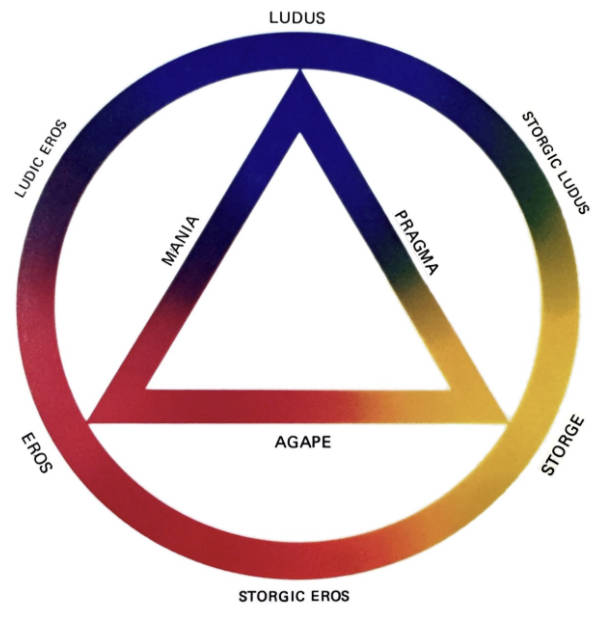
Iʼd like to have fun interpreting the relationships in Hamlet using this concept. I should also address the title of this essay: Love Is a Color Wheel (And Iʼm Colorblind). Disclaimer: As someone who has never experienced romantic attraction, everything Iʼm about to say about romantic relationships could be totally wrong. I like Leeʼs theory of love because there is no definitive line between romantic and platonic love; itʼs up to the individual to define where their love falls on the spectrum. A relationship can be characterized by multiple types of love (or exist on another plane altogether, but thatʼs a topic for another day), which is exactly what happens in Hamlet.
Love in Hamlet
Hamlet and Horatio
When Hamlet bids Horatio, Barnardo, and Marcellus farewell, he calls to them “Your loves, as mine to you” (Shakespeare 1.3.276). Wilson characterizes such love as philia, the Ancient Greek term for “friendship.” However, I believe the relationship between Hamlet and Horatio can be better described as storge, which Lee defines as “friendship gradually growing into a committed love” and “a feeling of natural affection” (Lee 79). First of all, Hamlet and Horatio are friends, no doubt; Hamlet directly calls him that (Shakespeare 1.2.169). In Act III Scene 2, Hamlet tells Horatio all about his play-in-a-play plan, which underscores his trust in Horatio. Furthermore, Horatio is always there to accompany Hamlet, appearing in many important scenes including the graveyard scene. There is a closeness between the two that Hamlet doesnʼt have with anyone else. The dynamic between Hamlet and Horatio, where Hamlet drones on while Horatio listens patiently and responds with an “Ay, my lord” (Shakespeare 5.1.89), embodies the spirit of storge, which is often described as an “uneventful kind of loving” (Lee 77). If you account for the murders, Hamlet and Horatio are partners in crime (Horatio being the enabler, never saying “no” to Hamlet). If you focus solely on their interactions, itʼs mundane and filled with peaceful, enchanting affection. They exemplify trust and loyalty, the foundation of a storge relationship.
The two are committed to one another, though Horatio more so than Hamlet. Horatio is Hamletʼs “poor servant” (Shakespeare 1.2.168), always “at [his] service” (Shakespeare 3.2.55). This makes him an agapic lover, loving Hamlet with “complete disregard for personal gain of any kind” (Lee 140). Horatio has one purpose: to support Hamlet, always. Really, he had nothing to gain from the whole debacle and he puts Hamlet above all else. “More an antique Roman than a Dane,” he goes as far as to attempt suicide because he doesnʼt want to live in a world without Hamlet (Shakespeare 5.2.374). However, even if it means carrying a great deal of grief for the rest of his life, he is willing to live simply because Hamlet asked him to. (Survivorʼs guilt, anyone?) If that isnʼt the definition of agape—a love that is “dutiful, unselfish, and self-sacrificing”—then I donʼt know what is (Lee 16). Even as Hamlet descends into madness, he loves him and follows him to his tragic end.
Hamlet and Ophelia
But wait, thereʼs another pair of doomed star-crossed lovers: Prince Hamlet and Sweet Ophelia. In Hamlet, Polonius calls the love between Hamlet and Ophelia “hot love on the wing,” which Wilson interprets as “romantic love” or “what the Greeks call eros” (Shakespeare 2.2.141). This is further evidenced by one of Hamletʼs love letters to Ophelia:
Doubt thou the stars are fire,
Doubt that the sun doth move,
Doubt truth to be a liar,
But never doubt I love. (Shakespeare 2.2.124–127).
Their love burns bright, but soon flickers and dies. Wilson explains that the downfall of their relationship stems from Ophelia feeling like “[her] love for Hamlet [is] not returned.” But maybe itʼs not so much unrequited love as mismatched expectations of love. In an erotic relationship, sometimes joy is achieved “for a short time” but then “disintegrates . . . when the partner is not mutually erotic” (Lee 39). Ophelia, convinced by Hamletʼs “words of so sweet breath,” has come to expect eros or passionate love (Shakespeare 2.2.107). Not only does Hamlet proclaim that he “loved [her] not” (Shakespeare 2.2.129), but his behavior during the play-within-a-play scene suggests ludus, game-playing or uncommitted love. He plays “naught”: he lies on Opheliaʼs lap and teases her with innuendos (Shakespeare 3.2.119–131). This is the textbook definition of a ludic lover who sees “love as a desire to want to have fun with each other . . . [to] tease, indulge” (Rahman). Hamlet, whether genuinely or not, puts on a ludic act that ultimately breaks Opheliaʼs heart.
Claudius and Gertrude
While everyone sees Hamlet and Ophelia as two youngins in hot love, the case of Claudius and Gertrude is a little different. Wilson characterizes both relationships as eros, “passionate physical and emotional love” (Rahman). Claudius certainly claims that Gertrude is the love of his life, citing her as one of the “effects [rewards] for which [he] did the murder” of the Old King Hamlet (Shakespeare 3.3.58). The Ghost calling Claudius an “adulterate beast” who “won [Gertrude] to his shameful lust” also seems to support the case of a passionate, erotic love (Shakespeare 1.5.49–52). However, I believe what distinguishes Claudius and Gertrudeʼs relationship from that of Hamlet and Ophelia is that their relationship is also a practical one—pragma. The death of King Hamlet resulted in Denmark being perceived as a “disjoint and out of frame” state (Shakespeare 1.2.20). In response, Claudius uses his marriage with Gertrude to revitalize the kingdom, sending the political message that Denmark has moved past the death and is as strong as ever. From the political marriage, Gertrude gets to keep her noble status as queen. This fits the definition of pragma as a “mutually beneficial relationship” (Dewey). Ultimately, Gertrude and Claudiusʼ relationship is arguably the first and most consequential tragedy in Hamlet. If they hadnʼt been married or involved, maybe Hamlet would still have trusted his mother and been more level-headed; maybe Claudius wouldnʼt have killed King Hamlet in the first place.
Conclusion
The story of Hamlet explores many different kinds of love. There is no one correct way to categorize these relationships as love is simply complicated. That said, using the color wheel theory of love, I interpret Hamlet and Horatioʼs relationship as a companionship (storge), with selfless love (agape) from Horatio. Hamlet and Opheliaʼs passionate, romantic relationship (eros) was destroyed by Hamletʼs ludic act (ludus). Claudius and Gertrudeʼs relationship is both romantic (eros) and politically practical (pragma). At the end of the day, no matter what kind of love, it can always turn tragic. The best thing a person can do is to cherish their partners, whether platonic, romantic, familial, somewhere in between, or outside the color wheel of love.
Afterthought
This has nothing to do with Hamlet, but I figured Iʼd note this down because I found it fascinating. The life of John Alan Lee, the creator of the color wheel theory of love, is quite a story. While researching for this essay, I came across his personal website, which contains his autobiography. His writing style is very personal and gentle, and Iʼm thoroughly intrigued by what his life was like, especially his experiences with love.
The following is an excerpt from the Acknowledgements of his book Colours of Love: An Exploration of the Ways of Loving:
I chose to study love not merely because it is important and interesting in general, but because it has been important to me. I especially hold dear the revelations of love shown me by Jean, Chris and Francis, none of whom are with me now, for I, too, pursue the impossible dream.
Works Cited
Dewey, A. “Six Types of Love.” Psych Web, www.psywww.com/intropsych/ch16-sfl/six-types-of-love.html. Accessed 14 April 2024.
Lee, A. John. Colours of Love: An Exploration of the Ways of Loving. New Press, 1973.
Rahman, Susan, et al. “8.4: Love Styles.” LibreTexts, socialsci.libretexts.org/Bookshelves/Gender_Studies/Sexuality_the_Self_and_Society_(Ruhman_Bowman_Jackson_Lushtak_Newman_and_Sunder)/08%3A_Attraction_Love_and_Relationship_Formation/8.04%3A_Love_Styles. Accessed 14 April 2024.
Shakespeare, William. Hamlet. Simon & Schuster, 2012.
Wilson, R. Jefferey. “Whatʼs Love Got to Do with Hamlet?” Shakespeare Magazine, www.shakespearemagazine.com/2020/11/whats-love-got-to-do-with-it-quite-a-lot-actually-when-it-comes-to-the-key-characters-of-hamlet-jeffrey-r-wilson-throws-light-on-shakespeares-fascinating-foray-into-perhaps-the-most-complex-e/. Accessed 14 April 2024.