"A Letter From Santa Claus" Choice Piece Artist Statement
Summary:
Recreating the toy box in "A Letter From Santa Claus" and my artist's statement.
Notes:
This was a collab with a friend of mine! My friend made two additional doll clothes.
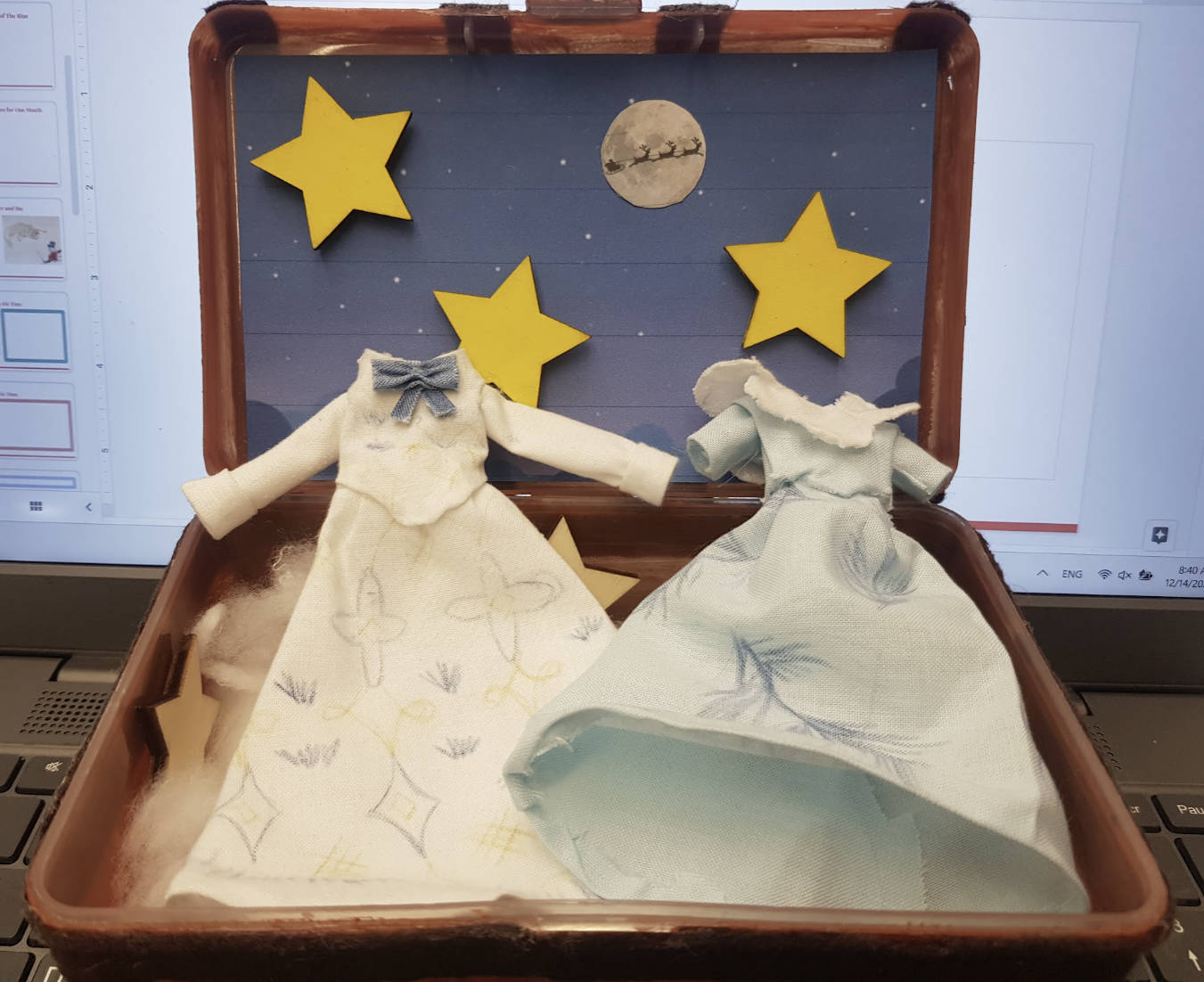
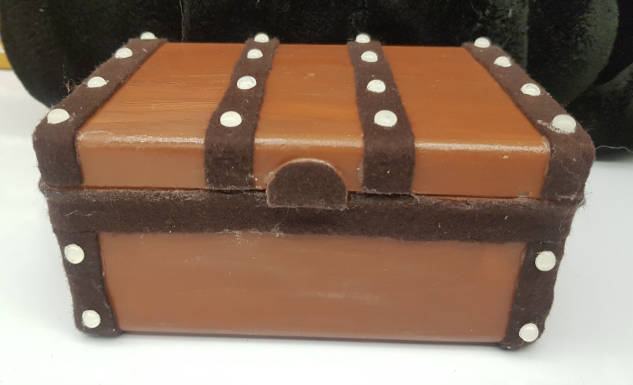
In the short story “A Letter From Santa Clause” by Mark Twain, Susy, Twainʼs daughter wants a trunk full of doll clothes for Christmas. I knew I wanted the choice piece to involve the trunk of doll clothes as it is the driving force behind the plot of the story. From there, my partner Raelyn and I came up with the idea that we would make a miniature model of the trunk from the story, as well as some doll clothes. I was in charge of making the box and two of the doll clothes. I wanted the trunk and the doll clothes to be accurate to the time that the letter was written — 1875 — but also with my own twist to it. Neither the trunk nor the doll's clothes were described in detail in the story. I assumed the clothes to dress, as female dolls with dresses seem to be the most prominent.
Susy had written a letter to Santa Claus asking for a trunk of doll clothes. And not wanting to disappoint his daughter, Mark Twain pretended to be Santa Claus and wrote her a letter back. In the letter, Santa said he would visit Susy and ask her “what color [she] want[s] the trunk to be.” I did not want to just pick a random color, so I decided to make a generic trunk that is reflective of the time period. I have a plastic container lying around; I painted it a wooden brown color and customized it with the two prominent features of trunks from the late 1800s: leather straps and gold brass rivets. The leather straps are made of felt and the rivets are circles made of paper with a dab of hot glue on top. Inside the trunk is a 3D backdrop of the night sky. In the center lies a moon and the silhouette of Santa and his reindeer. This is a reference to how in the story, Santa promised that he would “go to the moon” to retrieve the gifts. This characterizes the mythical and mysterious manners of Santa. It also reflects the culture of the time in which the story was written, in which Santa Claus lived on the moon, not at the North Pole as we think of it today. The comically large, bright, yellow, cartoon stars are my interpretation of Christmas as imagined and drawn by a child, like Susy. Last but not least, the two doll dresses I made are simplified designs inspired by doll dresses from the 1860s and 1870s.
Overall, this story and choice piece gave me some insights into what Christmas was like back in the days, in the late 1800s. My family does not celebrate Christmas, so I got to experience Christmas through the perspective of a loving parent (Mark Twain who wrote the letter pretending to be Santa) and the perspective of a young kid who is all so excited to meet Santa and receive their gifts. An interesting thing I noticed while researching is that doll dresses back in the day had more of a dull color compared to the saturated colors we see on dolls today. Itʼs also very interesting to see how the depiction of Santa didnʼt really change even after nearly 150 years; he still goes down the chimney and keeps a naughty list. This choice piece reaches Depth of Knowledge Level 2, summarizing important elements of a text, as it is a synthesis of the important elements of the story. Being an original creation based on the story, it also reaches Level 4 of constructing an original interpretation. The project also connected with the technological aspect of ESLO, as I had to utilize digital resources to conduct research on the topic, such as finding reference images. Furthermore, it is a collaborative effort that requires students to be effective communicators with their partners.
If I were to describe in one sentence how the I felt reading this story, it would be that it made me want to be a little kid again, to feel the holiday spirit and experience a true Christmas.