Mathematical Exploration Project: Sudoku
Summary:
A brief history of Sudoku and how it relates to math, along with an accompanied artwork.
Notes:
The Math Exploration Project is a yearly assignment that my high school math teacher gives out to his 10th and 11th grade students. It's kind of a fun tradition. In this project, we create a one-page article, an artwork, and a reflection on a topic—any topic—related to the application of mathematics. It's inspired by a book (that I've since forgotten the name of) that's like 300 pages of Math Things each accompanied by an artwork or photo that spans an entire page. This is the artwork I created for the project:
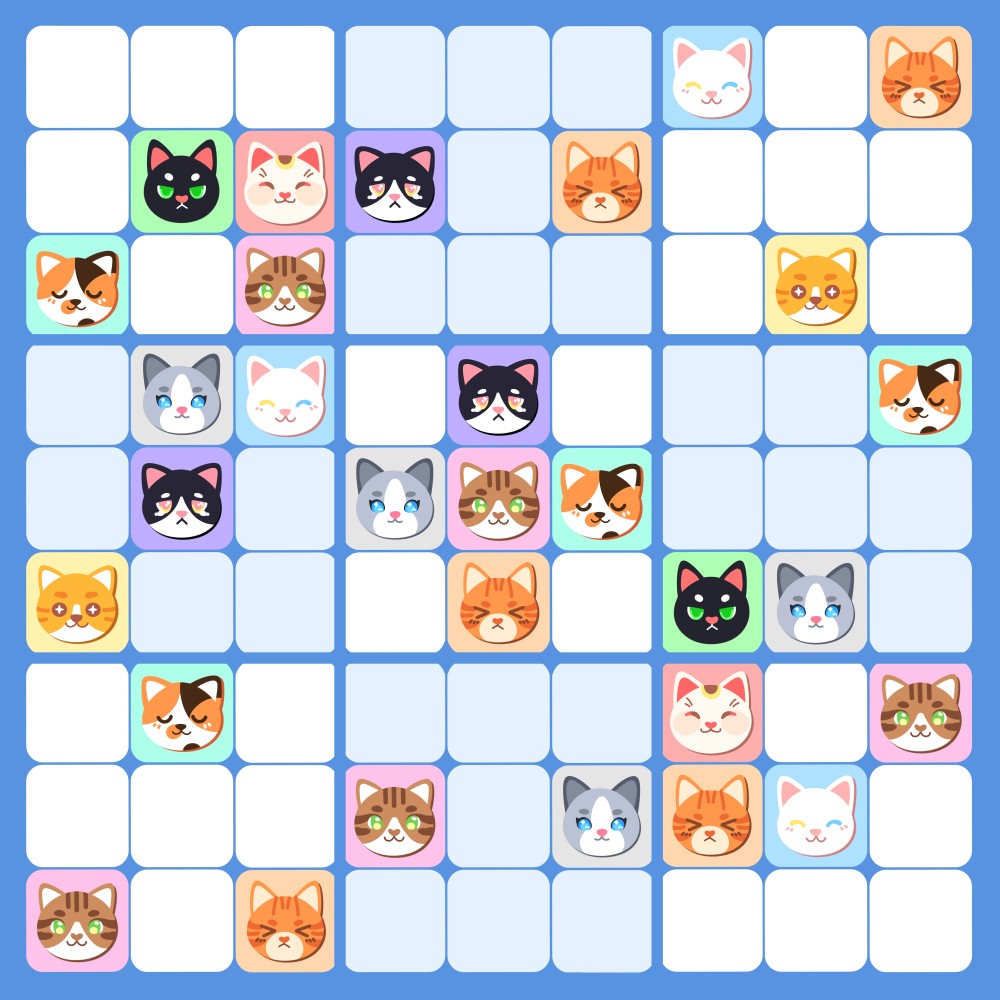
Sudoku, but cats :3
You can find the 2023 Math Exploration Project here!
Sudoku is a logic-based number-placement puzzle game. The word Sudoku derives from the Japanese phrase Suji wa dokushin ni kagiru (数字は独身に限る), meaning “the numbers must be single,” which was later abbreviated to Sudoku (数独). Despite what its name may suggest, modern Sudoku has its roots, not in Japan, but the United States.
In 1979, Dell Magazine published a number puzzle called “Number Place” in its Pencil Puzzles and Word Games magazine. The goal is to place the numbers 1 through 9 into a 9 × 9 grid so that each column, row, and 3 × 3 boxes contain each number without repeating. Although there was never official confirmation, it is believed that Howard Garns, a retired architect and freelance puzzle creator from Indiana, is the creator of Number Place. His name was always present in the credits whenever Number Place appeared in the magazine and was absent otherwise.
The popularity of Number Place began to grow after it was introduced to Japan in 1984 under the name Suji wa dokushin ni kagiru by a company called Nikoli. Two new rules were added and it became the Sudoku we know today. First, no more than 32 numbers can be given at the beginning of the puzzle. Second, the given numbers must form a symmetrical pattern. The game quickly became popular in Japan and soon across the globe. Sudoku owes its worldwide fame to Wayne Gould, who developed a computer program that can generate sudoku puzzles at various levels of difficulty. In 2004, he convinced The Times to publish some of his Sudoku puzzles in its newspaper. Since then, Sudoku has become a global phenomenon. First Japan, next, the United Kingdom, then back to the United States, and eventually, the rest of the world.
Sudoku has been used to train artificial intelligence, such as the Deep Reasoning Networks (DRNets). Although the puzzle seemed simple enough, mathematicians Bertram Felgenhauer and Frazer Jarvis have determined that there are 6,670,903,752,021,072,936,960 possible 9 × 9 Sudoku puzzles by looking at all possible grids and counting the ones that are Sudoku grids.
“What Is Sudoku.” Mental Itch, 19 Jan. 2022, mentalitch.com/what-is-sudoku.
Nirbhaya. “The History of Sudoku.” Onhike, 16 Oct. 2021, onhike.com/the-history-of-sudoku/156578.
“History of Sudoku.” Sudoku Online, Mar. 2020, www.sudokuonline.io/tips/history-of-sudoku.
Nolte, Harold.“Sudoku History.” Sudoku Primer, Oct. 2015, sudokuprimer.com/history.php.
Jarvis, Frazer, and Bertram Felgenhauer. “Sudoku Enumeration Problems.” Frazer Jarvis, 2 Feb. 2008, www.afjarvis.staff.shef.ac.uk/sudoku.
Weigel, Markus. “What Is Sudoku?” Sudoku Space, www.sudoku-space.com/sudoku.php. Accessed 22 Mar. 2022.
Calmes, Jordan, et al. “Sudoku.” Brilliant, brilliant.org/wiki/sudoku. Accessed 22 Mar. 2022.
Fleischman, Tom. “DRNets Can Solve Sudoku, Speed Scientific Discovery.” Cornell Chronicle, 17 Sept. 2021, news.cornell.edu/stories/2021/09/drnets-can-solve-sudoku-speed-scientific-discovery.
Q1. Why did you choose this particular item for your project?
I chose Sudoku for my project because it was one of the first things that came to my mind. I've played Sudoku since I was very little. It's not my favorite game ever, but it's a nice, simple puzzle game that I sometimes find myself spending time playing when I'm bored. I thought it would be fun to focus my project on it because it's something I'm familiar with. Plus, since it's pretty popular/well known, it wouldn't be too difficult to research.
Q2. What was one thing you did not know about your item prior to selecting it that you learned along the way?One thing I did not know before researching Sudoku was that it originated in the United States. Because of its name, I just assumed it's probably from somewhere in Asia (either Japan, China, or Taiwan). Fun fact, the name “Sudoku” is spelled the same in Chinese and Japanese because they use the same characters: 数独.
Q3. How did you decide what to create for the artwork design OR why did you decide on the specific creation that you included on the second page?For the artwork, I decided to draw Sudoku -- but with cats! Because Sudoku is logic-based, not math-based, it doesn't strictly have to use numbers. So I started brainstorming about what nine symbols to draw. I thought about drawing rockets, but that would be too complicated. My next idea was the planets of the solar system, but there are only eight of them. Eventually, I settled down on cats because I love cats and I just so happen to have one at home :) The cat characters were inspired by my cat (his name is Gingerpie, he's the one on the yellow square), my favorite cat breeds, and other cats that just work well together in the color scheme.
Q4. How does this project connect to the appropriate grade-level theme(s)?The project connects to the 10th grade theme of “System, Structure, and Function” because the whole project can be considered a system. The system, which is the final product, has a structure consisting of a piece of writing and a piece of artwork, as well as a reflection. The structure of the system allows it to perform its function of conveying information about Sudoku.